Base vs Ethereum Mainnet Gas Fees: The 100x Difference, Explained
The 100x headline, and where it comes from
The marketing claim you'll see everywhere: "Base is 100x cheaper than Ethereum." Marketing being marketing, I checked.
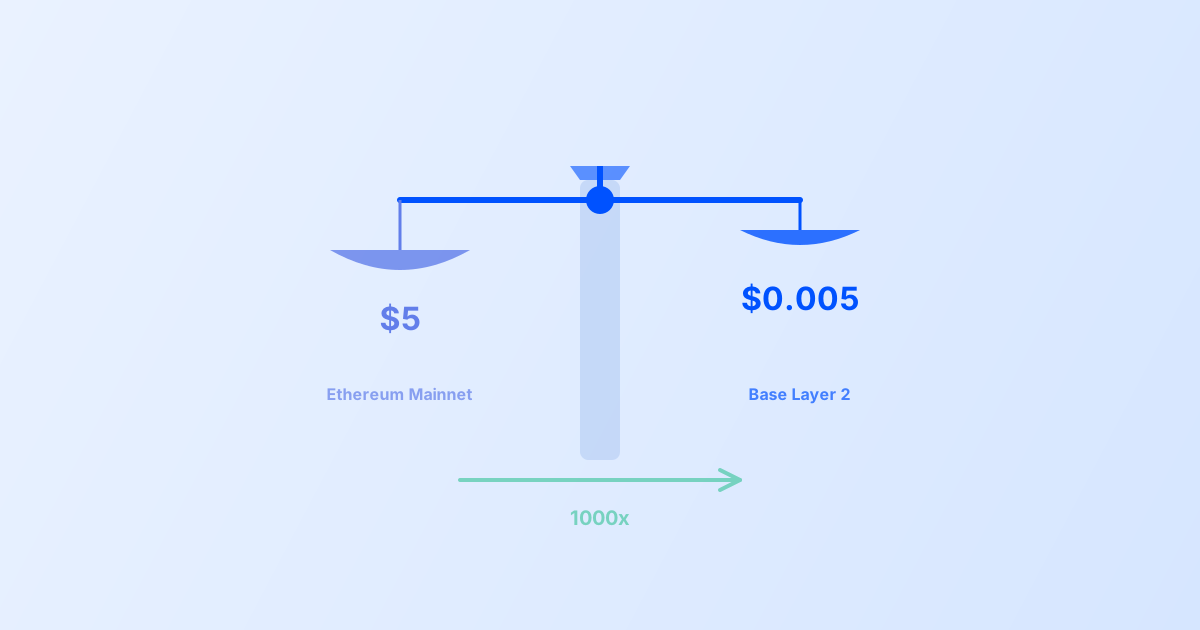
On a normal afternoon, a simple ETH transfer on mainnet costs $1 to $3 in gas. The same transfer on Base costs $0.001. That's a 1,000x gap, not 100x. A Uniswap swap on mainnet runs $5 to $30. On Base, the same swap is $0.002 to $0.005. That's a 1,000x to 6,000x gap.
So the headline undercounts it. The gap is real, structural, and bigger than the marketing.
What $5 of mainnet gas looks like on Base
Five dollars on mainnet gets you one Uniswap swap, maybe a token approval if you're lucky.
Five dollars of gas on Base gets you roughly 1,000 to 2,500 swaps. A thousand. Same five bucks. Same network underneath. The difference is that Base batches thousands of transactions into one mainnet receipt and splits the cost across everyone in the batch. You pay your slice — about a thousandth of the mainnet cost — instead of the whole thing.
This is why people say L2 feels like a different industry. It kind of is.
Why the gap is structural, not promotional
Two architectural facts drive the 100x-and-up gap.
First, execution moves off mainnet. Base runs its own sequencer that processes transactions every 2 seconds. Mainnet only sees the compressed result, not each individual transaction.
Second, data gets posted in batches. A thousand Base transactions become one blob of data posted to Ethereum. The cost of posting that blob gets split a thousand ways. Each user pays roughly 1/1000th of the mainnet fee they would have paid solo.
This isn't a promo. It's the rollup trick, and it's the same trick every L2 uses. The full Base fees guide breaks it down further if you want the mechanism.
The catch: getting onto Base still costs mainnet money
Here's where people get burned. The chain is cheap. Getting onto the chain is not.
Bridging ETH from mainnet to Base costs $2 to $15, because that bridge transaction runs on mainnet. It's the same expensive computation, paid in full, no batch to split it across.
This is why the order of operations matters. If you bridge $100 of ETH to Base and immediately do a $5 swap, you've spent 15% of your stack on gas. If you bridge $5,000 and then do that same swap, the bridge fee is 0.2% of your stack and the swap is invisible. Size matters. Small dollar amounts don't justify a bridge — the bridge cost eats the savings. Check the Base calculator before you commit.
When you should just stay on mainnet
Honest answer: most retail users shouldn't be on mainnet at all. L2s exist for a reason, and that reason is you.
The exception is if you're doing something that genuinely needs mainnet liquidity — a specific NFT mint that only happens on L1, an airdrop claim that requires mainnet interaction, a stablecoin operation that has no L2 presence. In those cases, pay the mainnet fee, get it done, then bridge the rest of your stack to Base for everyday use.
If you're just swapping tokens or moving ETH between wallets, mainnet is a tax, not a choice. Use Base. The Base tracker shows you the live cost, and 99% of the time it's a rounding error compared to the same action on mainnet.